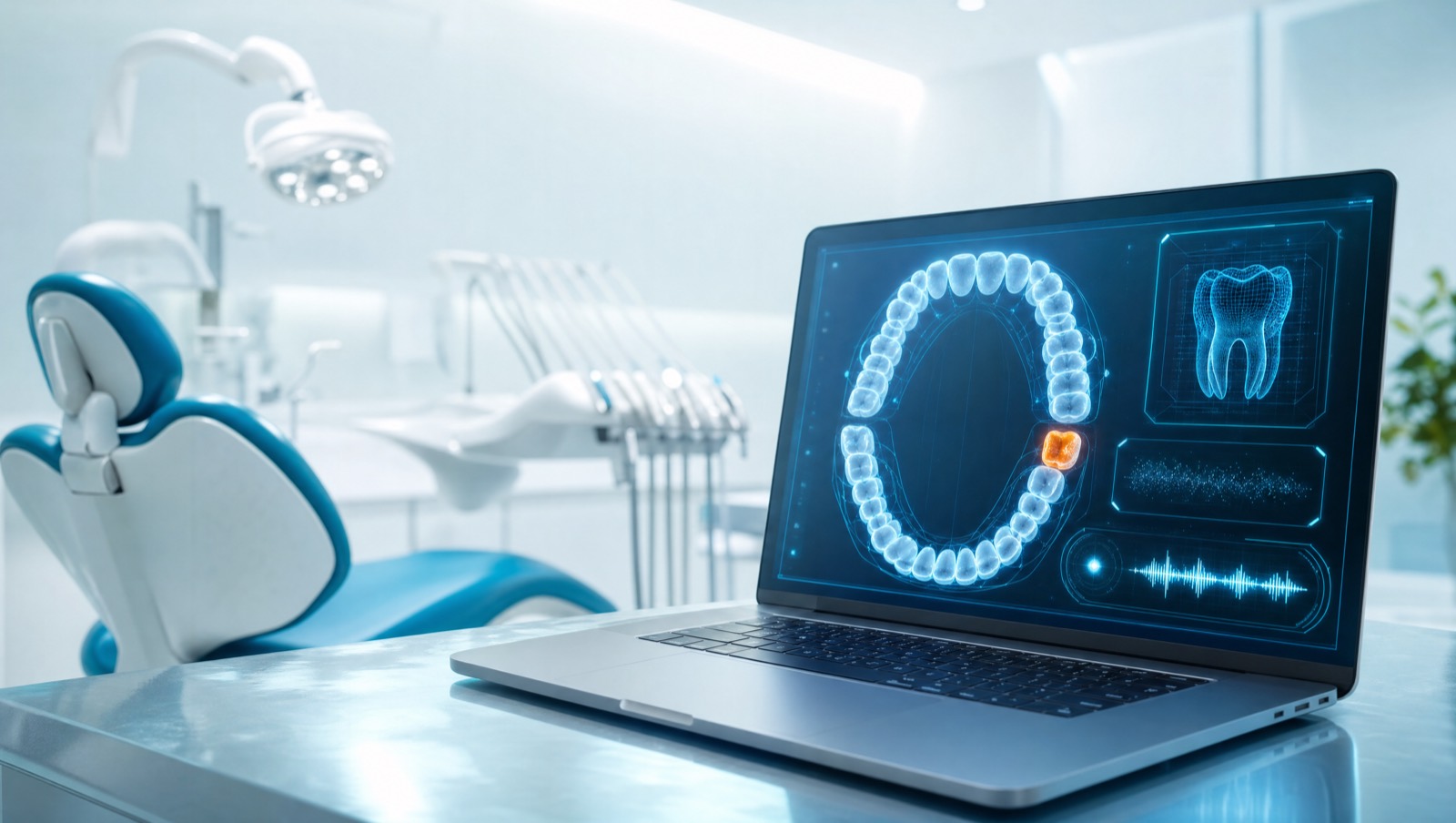
A lower molar with persistent pain. The bite-wing looks clean. You study it again, ask a colleague, and still sit with the decision: treat or refer. Every endodontist knows that hour. The promise of AI in my field is getting that hour back — without handing over the judgement that makes it yours.
I test these tools in a working practice in Dubai, and I write honestly about what helps and what doesn't. This is the version I'd want a colleague to read.
Takeaway: used well, AI sharpens diagnosis, speeds up decisions, and steadies instrumentation in root-canal treatment. Used lazily, it's one more way to stop thinking. The difference is the clinician, not the software.
What AI actually does in endodontics
Strip away the marketing and artificial intelligence in dentistry is pattern recognition trained on large sets of radiographs, CBCT scans, and clinical records. It reads imaging at a scale and speed no clinician can match, then flags what statistically looks like pathology, anatomy, or risk. That's all it is — and used properly, that's plenty.
Where it earns its place
Diagnostic imaging. A second set of eyes that never gets tired at 7pm. Models trained on periapical radiographs and bite-wings can highlight subtle bone loss, early resorption, or cystic change — the signs that are easiest to miss when the lesion is small or the image quality is poor.
Reading canal morphology. From CBCT data, AI can map the root-canal system and flag the anatomy that changes your plan — an extra mesiobuccal canal, an unusual curvature — and suggest an instrumentation sequence to match. Fewer surprises mid-treatment means fewer ledges and perforations.
Outcome prediction. Given patient-specific factors — age, systemic health, tooth type, extent of pathology — predictive models produce a risk estimate. That makes the prognosis conversation with the patient more honest, and the follow-up protocol easier to tailor.
What it's genuinely good at
Consistency, speed, and pattern recognition beyond the human eye. It doesn't fatigue, it doesn't anchor on the first thing it sees, and it reads a batch of images in seconds. In a busy practice that time goes back where it belongs — to the patient in the chair.
But notice the word I keep using: assistant. The moment the output becomes the decision, you've stopped practising dentistry and started supervising software. A flag for a missed canal is information. Whether to treat, refer, or watch is still yours.
How I'd bring it into a practice
- Pick a validated platform. Peer-reviewed evidence, and regulatory approval for your region — CE marking, FDA clearance, or your local equivalent. No validation, no purchase.
- Train the team. Everyone who touches the output should know what it means and when to override it.
- Start with one case type. Molar root canals are a good pilot — common, well-documented, easy to audit. Expand only when the pilot earns it.
- Log your outcomes. Keep a record of AI-assisted cases and check the tool's performance against your own results, not the vendor's brochure.
The honest limits
The evidence base is growing but young. Most studies measure image-analysis accuracy; long-term outcome data is thin. Performance figures from a validation study may not transfer to your equipment, your imaging protocol, or your patient population — so before you trust any metric, confirm it was measured under conditions that resemble yours. AI augments clinical expertise. It has never replaced it, and pretending otherwise is how patients get hurt.
Ethics aren't optional
- Privacy — patient data used for training or operation must be anonymised and stored securely.
- Transparency — patients deserve to know when AI plays a role in their care, and what that role is.
- Accountability — the final treatment decision belongs to the clinician. That doesn't move, whatever the software suggests.
Where this is going
Three directions worth watching: deep learning over full CBCT volumes for finer morphology prediction, real-time guidance during instrumentation as navigation systems mature, and genuinely personalised protocols built from patient-specific risk. Worth tracking — not worth waiting for. The tools that help today, help today.
My working rule
Let AI narrow the differential. Never let it make the decision. The tool reads the radiograph; you treat the patient.
This content is for educational purposes and does not replace professional dental or medical advice.